

A Guide To LED Video Wall Installation
Across commercial and institutional environments, LED video walls have become a critical communication tool. Organizations rely on large-format displays to share real-time information, support collaboration, reinforce branding, and deliver messages that need to be seen clearly across expansive spaces.
Unlike traditional displays, LED video walls are integrated into the physical environment. Their performance depends not only on display technology, but on how well the system is planned, engineered, and installed within the facility, including coordination with the underlying structured cabling system that supports data, power, and signal reliability. When executed properly, an LED wall becomes a dependable asset. When planning is rushed or fragmented, issues with visibility, reliability, and long-term maintenance quickly surface.
Understanding the considerations behind a successful LED video wall project helps decision-makers set realistic expectations and avoid costly rework.
Defining the Purpose of the Display
Effective LED video wall projects begin with clarity around how the display will be used. Some environments require continuous data visualization, while others focus on presentations, announcements, or brand storytelling. Viewing distance, audience size, and frequency of use all influence design decisions.
Large open spaces may demand high brightness to overcome ambient light, while closer viewing areas require tighter pixel spacing for image clarity. Identifying the role the display plays within daily operations allows teams to align design decisions with business objectives rather than technology features alone.
Integrating the Display Into the Physical Space
LED video walls are architectural elements as much as technology systems. Their placement affects sightlines, room flow, and how people interact with the space.
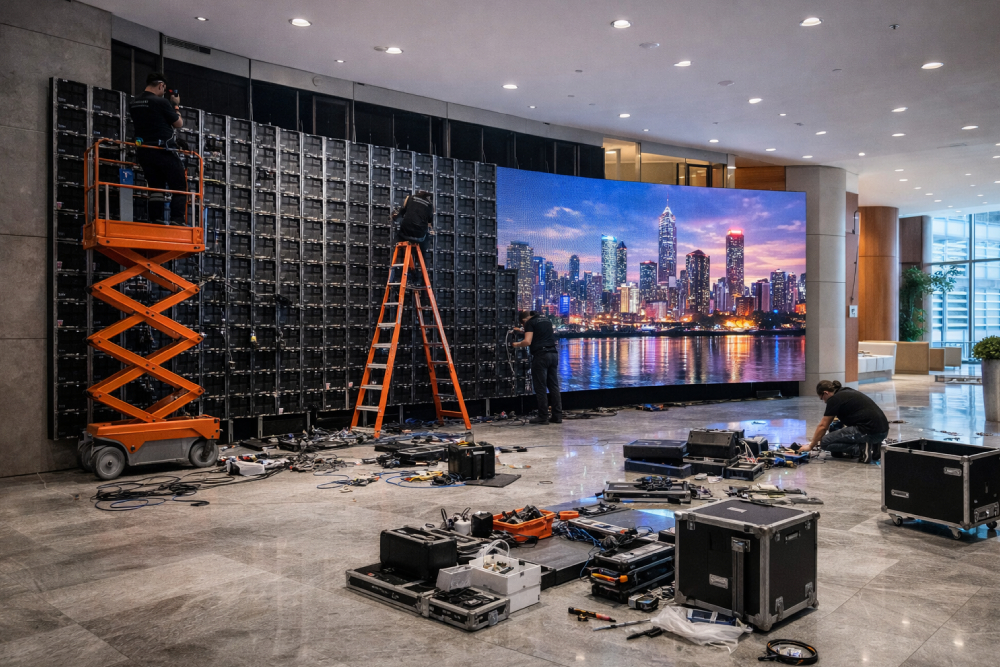
Mounting considerations include wall structure, available depth, and load capacity. Some environments call for recessed installations that create a seamless appearance, while others require surface-mounted structures that allow easier access for service. Each approach has implications for long-term maintenance and system accessibility.
Careful coordination with surrounding architectural features, lighting, and building systems ensures the display complements the space rather than competing with it.
Accounting for Power and Environmental Conditions
Reliable performance depends on more than display panels alone. LED video walls require consistent electrical infrastructure that supports brightness levels and operating hours without interruption.
Environmental conditions also play a significant role. Heat management, airflow, and temperature stability influence system longevity. Displays installed in spaces with limited ventilation or wide temperature fluctuations require additional planning to prevent premature wear.
Evaluating these conditions early allows organizations to address infrastructure needs before installation, rather than reacting after performance issues appear.
Supporting LED Video Walls With the Right Infrastructure
LED video walls rely on dependable data network infrastructure to deliver high-resolution content consistently. Whether supporting live dashboards, digital signage, or collaborative content, signal reliability is essential.
Structured cabling provides predictable signal pathways and simplifies long-term service. Infrastructure planning should consider distance, signal integrity, and coordination with other audiovisual systems in the facility.
When infrastructure is treated as an integral part of the display system, organizations experience fewer interruptions and greater consistency in daily operation.
Planning for Content Use and Operational Demands
While LED video walls enable creative and flexible content layouts, the way content is managed influences system design. Displays that support multiple content sources, real-time updates, or scheduled messaging require thoughtful coordination between processors, inputs, and control systems.
Understanding how teams will interact with the display helps shape design decisions that support usability without unnecessary complexity. Planning these needs early reduces friction during daily use and helps ensure the display delivers ongoing value rather than becoming an underutilized asset.
Why Professional Execution Matters
LED video wall projects involve coordination across structural, electrical, and audiovisual disciplines. Precision during installation directly affects visual alignment, uniformity, and long-term reliability.
Professional execution ensures:
- Displays are mounted securely and evenly
- Power and data systems are integrated properly
- Visual performance is consistent across the entire wall
- Documentation supports future service and expansion
Without experienced execution, even high-quality components can fail to meet expectations once installed in a real-world environment.
Thinking Beyond Day-One Performance
A successful LED video wall project considers not just initial impact, but long-term operation. Displays that are accessible for service, supported by organized infrastructure, and installed with environmental conditions in mind tend to perform more reliably over time.
Organizations that plan with longevity in mind experience fewer disruptions and gain more value from their investment.
Our Approach to LED Video Wall Projects
Alliance Telecommunications approaches LED video wall projects as part of a broader audiovisual ecosystem. We focus on designing and integrating displays that function reliably within active commercial and institutional environments.
Our work accounts for physical infrastructure, space constraints, environmental factors, and operational goals before installation begins. By aligning planning, integration, and execution, we deliver LED video wall systems that support clear communication and dependable performance across facilities.
To discuss LED video wall projects and audiovisual solutions designed for real-world environments, contact Alliance Telecommunications to speak with a technology specialist about your facility’s needs.