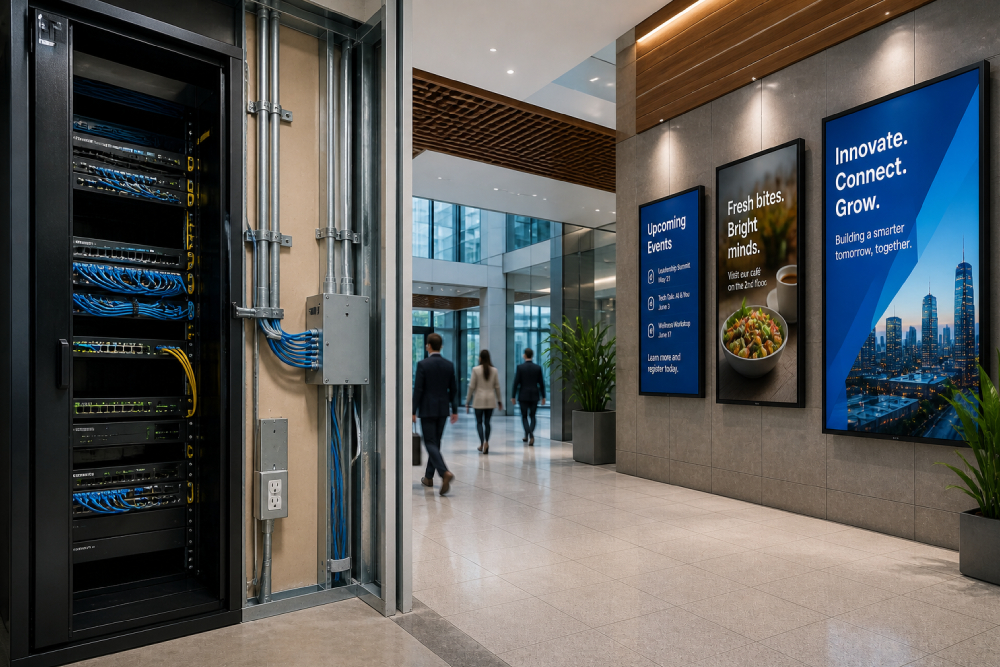


Why Digital Signage Planning Starts With Infrastructure, Not Screens
When businesses decide to invest in digital signage, the conversation often begins with displays, content, and placement. Screens are selected, graphics are discussed, and mounting locations are identified. What is frequently overlooked is the part of the system that determines whether those displays will operate reliably for years or become a recurring source of service calls and performance issues.
Digital signage is not simply a screen on a wall. It is a physical technology system that depends on structured cabling systems, stable data network infrastructures, proper power distribution, and coordinated audio-visual solutions working together inside the building.
For facilities directors, IT managers, and operations leaders, the real planning work happens long before a display is mounted.
The Business Challenge Behind Digital Signage
Digital signage is typically introduced to solve a business need. Organizations want to improve internal communication, guide visitors through large facilities, promote services in public spaces, or create engaging experiences in lobbies, conference areas, and common spaces.
However, when signage systems are treated as isolated displays rather than integrated building technology, several issues tend to appear:
- Screens lose connection to content sources
- Media players are installed in inaccessible locations
- Network bandwidth is not planned for continuous content delivery
- Power sources are not designed for long-term reliability
- Cabling pathways are improvised rather than engineered
These problems are not related to the quality of the display. They are the result of insufficient infrastructure planning.
Structured Cabling Systems Are the Foundation
Every digital signage display depends on structured cabling systems to carry both power and data reliably. These cable pathways must be planned from telecommunications rooms to display locations with attention to distance limitations, pathway protection, labeling, and future serviceability.
When cabling is an afterthought, businesses often experience intermittent outages, signal degradation, or difficulty servicing equipment later. Properly installed cabling ensures that displays remain consistently connected to the network and content sources without disruption.
This is why digital signage planning must begin with the same discipline used for data network infrastructures.
Data Network Infrastructures Must Support Continuous Content Delivery
Unlike many office devices that operate intermittently, digital signage runs continuously. High-resolution video, live data feeds, and scheduled content updates place ongoing demand on the network.
Without evaluating how displays will interact with existing data network infrastructures, organizations may unintentionally create network congestion or unreliable content delivery. Professional planning accounts for bandwidth requirements, network segmentation, and secure connectivity that keeps displays performing without affecting other business systems.
This coordination is especially important in facilities with multiple displays across floors or buildings.
Display Placement Is About More Than Visibility
Choosing where to place a screen involves more than finding a visible wall. Installers must consider:
- Access to structured cabling pathways
- Proximity to power sources
- Mounting surfaces capable of supporting commercial displays
- Lighting conditions that affect visibility
- Safe and accessible locations for media players and service access
These considerations affect not only how the display looks on day one but how easily it can be maintained and supported over time.
Digital Signage as Part of Broader Audio-Visual Solutions
Digital signage rarely operates alone. In many facilities, it is part of larger audio-visual solutions that include conference room technology, interactive displays, LED video walls, and presentation systems.
When these systems share infrastructure, planning must account for rack space, cable management, network capacity, and equipment organization. Treating signage as part of a unified technology environment results in cleaner installations and simpler long-term support.
This integrated approach also allows organizations to expand or adapt their systems without major rework.
Security Solutions and Content Control
Because digital signage connects to the organization’s network, it must also be considered within broader security solutions. Access to content management systems, media players, and network ports should be controlled to prevent unauthorized changes or misuse.
Professional installers plan for secure device placement, protected connections, and proper documentation so the system remains controlled and traceable within the facility’s technology environment.
Why Professional Execution Matters
Many digital signage issues appear months after installation. Cables become difficult to trace. Media players are mounted in inaccessible ceilings. Network ports are undocumented. Displays require troubleshooting that disrupts operations.
These situations are avoidable when the system is designed and installed by professionals who understand how structured cabling systems, data network infrastructures, and audio-visual solutions must work together.
The quality of the installation determines whether digital signage becomes a reliable communication tool or a maintenance burden.
Planning for Long-Term Reliability and 24/7 Support
Digital signage often runs in lobbies, hallways, healthcare facilities, campuses, and corporate environments where downtime is highly visible. When a screen goes dark, it reflects poorly on the organization.
Planning for long-term reliability includes proper documentation, labeled cabling, accessible equipment placement, and the availability of 24/7 support when issues arise. Ongoing support ensures that content updates, hardware adjustments, and system expansions can be handled efficiently as needs evolve.
How Alliance Approaches Digital Signage Installations
At Alliance Telecommunications Contractors Inc, digital signage is approached as part of a complete building technology system. Our team designs and installs the structured cabling systems, connects displays to stable data network infrastructures, integrates signage into broader audio-visual solutions, and applies appropriate security solutions to protect the system.
Every installation is planned for long-term performance, serviceability, and reliability. After installation, our team provides responsive 24/7 support to keep your system operating as intended.
If your organization is planning a digital signage project, speak with Alliance Telecommunications about designing a system built on reliable infrastructure and professional execution that supports your business communication goals.
Contact Alliance Telecommunications Contractors Inc to plan a digital signage system built on dependable infrastructure, expert installation, and long-term support.