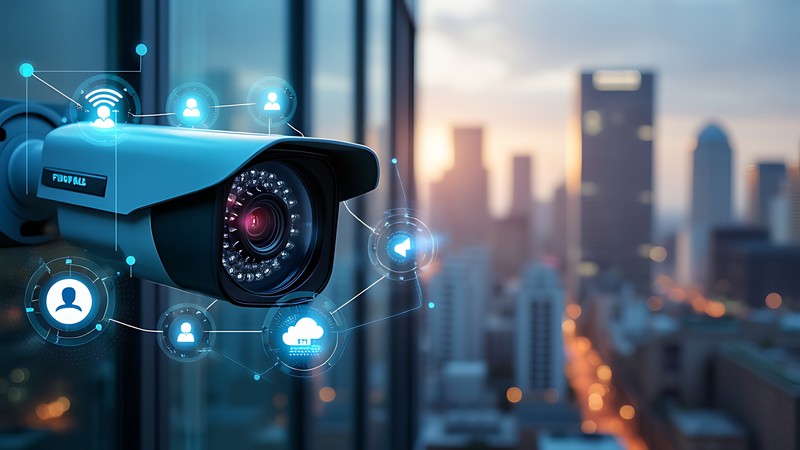


The Role Of AI In Enhancing Intrusion Detection Capabilities
Quick Summary
AI intrusion detection strengthens conventional security by reading activity patterns rather than fixed rules, which cuts false alarms sharply. It can separate people, vehicles, and animals and flag unusual behavior near restricted areas. Cameras, sensors, bandwidth, and storage all need assessing first, alongside integration with existing alarms and access control.
What is an intrusion detection system? In simpler terms, an intrusion detection system identifies unauthorized entry or suspicious activity inside a protected area, traditionally through sensors including door contacts and motion detectors, paired with predefined rules that raise an alarm whenever one of them is broken.
That model works well within its limits and struggles outside them. A motion sensor cannot separate an intruder from a shadow thrown by passing headlights, and a door contact cannot tell an authorized employee working late from someone who should not be in the building at all. AI intrusion detection is where that calculation has started to change, and it is reshaping how we design security solutions for our clients.
How AI Intrusion Detection Improves on Traditional Systems
An AI intrusion detection system uses machine learning models trained on large volumes of footage and sensor data to recognize patterns instead of relying purely on fixed thresholds. Rather than registering movement and raising an alarm, these systems weigh the type of movement, the time of day, and the context of the surrounding environment before deciding whether an event looks genuinely threatening.
That pattern recognition addresses the problem that has dogged intrusion detection for decades. False alarms erode trust quickly, and a monitoring team that has dismissed forty harmless alerts in a week responds more slowly to the forty-first, whatever the training manual says. Reducing the volume of noise reaching a human operator is therefore not a convenience; it is what keeps the genuine alerts meaningful.
Key Capabilities of AI-Driven Security Solutions
AI intrusion detection systems bring several capabilities traditional equipment cannot match. Video analytics can distinguish a person from a vehicle or an animal, letting security teams filter irrelevant alerts automatically. Behavioral analysis flags unusual patterns, including someone loitering near an entrance for an extended period or testing a restricted door outside normal hours.
Some platforms add predictive capability, drawing on historical incident data to identify the times and locations where problems are most likely to occur. That allows a business to weight its security resources toward genuine risk rather than treating every corner of a property as equally exposed at every hour of the day.
Reducing False Alarms and Improving Response Times
The most immediately practical benefit is the drop in false alarms. Basic motion sensors generate alerts triggered by wildlife, weather, and changing light, and a monitoring team exposed to that volume becomes desensitized to all of it, which slows the response when something real finally happens.
Filtering those false positives before they reach an operator keeps the remaining alerts credible enough to act on. That matters most for businesses relying on remote monitoring, where a flood of harmless notifications can overwhelm a small team and raise the odds of a genuine incident being missed or handled late.
Where AI Intrusion Detection Fits Alongside Other Security Systems
Intrusion detection delivers considerably more value when it shares information with the rest of a building’s security. Linking analytics to access control allows a system to correlate a flagged event with the credentials used at a nearby door, which turns two separate data points into one coherent picture of what happened.
The same applies to camera coverage. Pairing analytics with the right video surveillance systems gives a monitoring team both the alert and the footage that explains it, in one interface rather than two. A security solution operating in isolation from door access and alarms will always deliver less than one designed to trigger coordinated responses across all three.
Considerations Before Upgrading to AI Intrusion Detection
Businesses weighing an upgrade should work through a few practical questions first. Existing cameras and sensors need assessing for compatibility, since older equipment often cannot supply the resolution or frame rate modern analytics software depends on. Network bandwidth and storage capacity deserve the same scrutiny, as AI-driven video analytics generate substantial data volumes once the camera count climbs.
Integration with existing alarm and access control platforms is the third question, and it is the one most often deferred. Retrofitting integration after a system is commissioned costs more than designing for it from the start, and the businesses that get the most from these upgrades tend to be the ones that treated integration as a requirement rather than a later enhancement.
How Alliance Telecommunications Supports Security Upgrades
At Alliance Telecommunications, we design and install intrusion detection and broader security solutions built to integrate with the rest of a building’s low voltage systems. Our technicians assess the existing infrastructure, recommend the upgrades that are genuinely necessary, and handle installation from the cabling through to final configuration, so businesses are not coordinating three vendors through one security project.
Managing the entire low voltage scope, covering cabling, audiovisual, and security, lets us design intrusion detection that works alongside a client’s other technology rather than sitting beside it. Our service contract packages then keep the system tuned, since analytics need periodic review as a property changes, and access to 24/7 support means a fault does not wait for business hours.
Upgrade Your Intrusion Detection With Confidence
If your business is exploring AI intrusion detection or reassessing security infrastructure that has been in place for years, we can evaluate what you have and design a system that suits the property. Contact us to arrange a consultation with our security team.
FAQs
An intrusion detection system identifies unauthorized entry or suspicious activity using sensors and, in modern deployments, software that analyzes patterns of behavior rather than simply registering that a threshold has been crossed.
AI intrusion detection applies machine learning to separate genuine threats from harmless triggers, including wildlife, weather, and changing light, filtering those false positives out before they ever reach a monitoring team.
That depends on the age and specification of the equipment already installed, since analytics software has minimum resolution and frame rate requirements. A professional assessment before purchase avoids discovering the gap after commissioning.
Yes. Designed properly, AI intrusion detection shares data with access control and alarm systems to produce a coordinated response across the property rather than three systems reporting separately.
Yes. We handle the full scope of a security project, from structured cabling through equipment installation and configuration, which keeps responsibility for the finished system in one place.