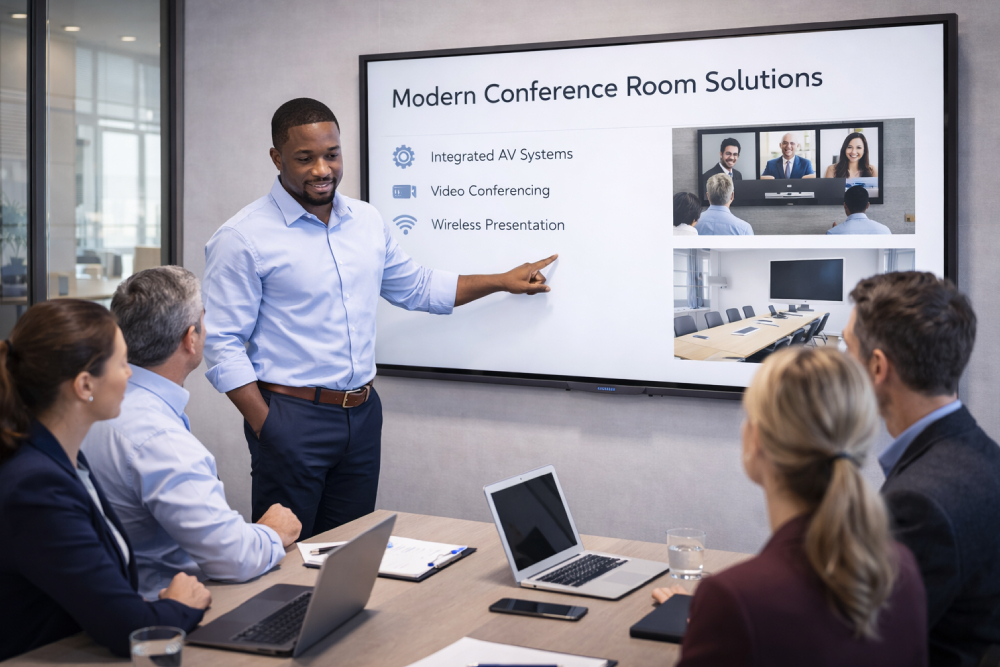


What Every Business Should Know About Interactive Multimedia
Interactive multimedia systems are no longer isolated enhancements added at the end of a project. In commercial environments, they affect how spaces function day to day-how teams collaborate, how information is shared, and how visitors move through a facility. When these systems are planned well, they support productivity and communication. When planning is fragmented, organizations face usability issues, unreliable performance, and costly retrofits after installation.
As businesses expand, renovate, or modernize their facilities, interactive displays, touch-enabled systems, and multimedia platforms are increasingly part of the conversation. These systems intersect with physical infrastructure, power availability, data pathways, mounting requirements, and room layouts.
Understanding how interactive multimedia fits into the broader built environment is essential for decision-makers responsible for long-term operations and capital investments.
Interactive Multimedia as a Business Infrastructure Decision
Interactive technology has shifted expectations across industries. Conference rooms are expected to support real-time collaboration. Training environments rely on responsive displays that guide users through complex processes. Lobbies and public spaces increasingly use interactive displays to direct visitors and communicate information clearly.
What often goes overlooked is that interactive multimedia is not just a display choice-it is an infrastructure decision. These systems rely on stable mounting, predictable signal delivery, coordinated audiovisual components, and physical integration with the surrounding space. A touch display that performs inconsistently or a kiosk that suffers downtime quickly becomes a source of frustration rather than value.
For business leaders, the focus should remain on how these systems support operational goals while remaining reliable under daily use. That outcome depends on how well the system is designed, installed, and supported over time.
Matching Interactive Systems to the Physical Environment
Different facilities place different demands on interactive systems. A boardroom requires displays that support annotation, content sharing, and visibility from multiple seating positions. A manufacturing training area may rely on interactive stations positioned for safe, repeated use by rotating teams. Healthcare and campus environments often require kiosks that withstand constant public interaction.
Planning begins with understanding how the space is used and how people move through it. Display size, mounting height, viewing distance, and accessibility all influence system effectiveness. Interactive elements must be reachable without creating congestion. Screens must remain readable under existing lighting conditions. Enclosures and mounts must support frequent use without compromising safety or aesthetics.
These considerations shape system selection and installation methods long before content appears on the screen.
System Design and Installation Considerations
Successful interactive multimedia deployments depend on thoughtful system design. Displays, controllers, input devices, and audiovisual components must operate as a coordinated system rather than standalone elements. Signal pathways, power requirements, and device locations must be mapped early to avoid conflicts during construction or renovation.
Physical installation decisions carry long-term consequences. Wall structures must support display weight and allow for service access. Floor-mounted kiosks require stable anchoring and protected cable routes. Interactive walls may need multiple signal connections to support touch data, high-resolution video, and audio simultaneously.
These systems often rely on a structured cabling system to maintain signal integrity and consistent performance across larger spaces. Planning cable routes, termination points, and equipment locations early helps prevent visibility issues, latency, or future limitations when systems need to expand.
Supporting Interactive Performance Through Network Infrastructure
Interactive multimedia systems frequently depend on real-time content delivery, system monitoring, and device coordination. While the technology itself may be visible, its performance is shaped by what happens behind the walls.
Wired infrastructure typically provides the most reliable foundation for interactive environments, particularly where high-resolution visuals and responsive touch input are required. Predictable bandwidth and stable connections help ensure that systems respond immediately to user interaction.
Wireless connectivity also plays a supporting role, especially in spaces where users connect personal devices or access supplemental content. Access point placement, coverage planning, and interference management all influence how smoothly these experiences function. Addressing these factors during system design avoids performance issues that can be difficult to resolve after installation.
Planning for Durability and Daily Use
Interactive systems are touched, used, and relied upon throughout the day. Displays in public or high-traffic environments must be built and installed to withstand constant interaction. Screen surfaces, mounting hardware, and enclosures should support durability without sacrificing usability.
Environmental conditions also matter. Heat management, dust exposure, and ambient noise levels can all influence system performance. Training spaces may require displays that remain visible under bright lighting. Collaboration areas benefit from audio solutions that support clear communication without bleeding into adjacent rooms.
Planning for these realities ensures that interactive systems remain functional and effective beyond the initial rollout.
Maintenance, Support, and Long-Term Operation
Interactive multimedia systems perform best when maintenance is considered part of the overall plan. Touch accuracy can degrade if surfaces are not maintained. Software platforms require updates to remain compatible with content and hardware. Sensors and input devices benefit from periodic checks to ensure responsiveness.
Ongoing support helps organizations protect their investment and minimize downtime. Many businesses choose to incorporate managed services after installation to monitor system health, apply updates, and address issues before they affect users. This approach allows internal teams to focus on operations while ensuring interactive systems continue to perform as intended.
Planning for long-term operation reinforces the idea that interactive multimedia is not a one-time purchase, but an operational asset.
Physical and Infrastructure-Level Security Considerations
Interactive systems placed in public or shared environments require practical security planning. Displays, kiosks, and controllers must be physically protected against tampering or accidental damage. Cable pathways should remain concealed or secured to prevent disruption.
Mounting systems play a role in safety as well. Properly installed hardware ensures displays remain stable under daily use. Equipment enclosures and access panels help limit unauthorized interaction with system components. When interactive systems connect to broader facility networks, segmentation at the infrastructure level can help isolate devices without introducing unnecessary complexity.
Addressing these physical and infrastructure-level considerations supports reliability while reducing risk.
How Alliance Telecommunications Approaches Interactive Multimedia
Alliance Telecommunications approaches interactive multimedia as part of a larger physical technology ecosystem. As a commercial technology contractor, our work centers on designing, installing, and supporting systems that perform reliably in real-world environments.
We evaluate how spaces are used, how systems integrate with existing infrastructure, and how installations will be maintained over time. Our experience across audiovisual systems, data network infrastructure, and ongoing support allows us to guide projects from early planning through long-term operation.
This perspective helps organizations deploy interactive multimedia systems that support communication, collaboration, and engagement without introducing unnecessary complexity. When planning aligns with professional execution, interactive technology becomes a dependable part of the built environment rather than a source of ongoing issues.
If you have questions about interactive multimedia planning or installation, contact Alliance Telecommunications to discuss how these systems can be designed to support your facility’s long-term goals.