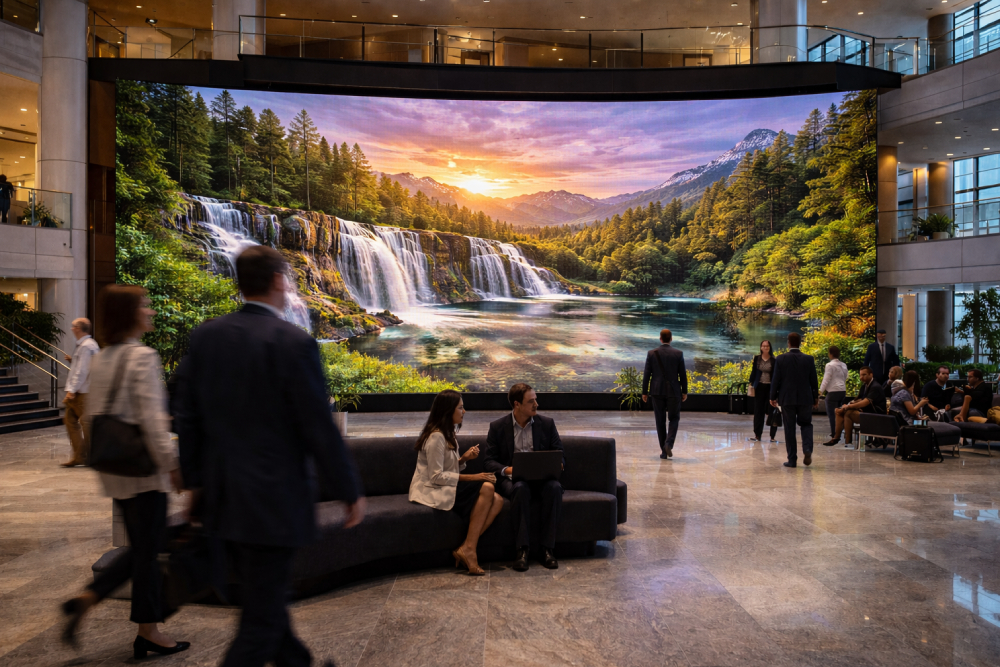


How Commercial AV Systems Shape Communication in Modern Facilities
In commercial environments, communication is increasingly visual, immediate, and shared across physical spaces. Organizations rely on audiovisual systems to deliver information clearly in conference rooms, lobbies, control centers, classrooms, and large common areas. When these systems perform well, they support productivity, coordination, and consistent messaging.
Unlike digital marketing tools or online media platforms, commercial audiovisual systems are permanent components of a facility. Displays, audio systems, and interactive technologies must operate reliably day after day while integrating with the building’s infrastructure.
Their effectiveness depends less on creative content and more on thoughtful planning, proper installation, and long-term system performance.
The Role of AV Systems in Commercial Communication
Large-format displays, distributed audio, and interactive screens are used to communicate information at scale. In corporate settings, they support presentations, collaboration, and internal messaging. In healthcare and education, they deliver wayfinding, alerts, and instructional content. In industrial and operations-focused environments, they display real-time data and system status.
These systems must remain clear, consistent, and dependable regardless of lighting conditions, room acoustics, or audience size. Achieving that reliability requires more than selecting the right screen or speaker-it depends on how the entire system is designed to function within the space.
Why Physical Environment Matters
Audiovisual performance is directly influenced by the physical environment. Room size, ceiling height, surface materials, ambient noise, and viewing distance all affect how content is seen and heard. A display that performs well in a boardroom may be ineffective in a lobby or manufacturing space.
Sound distribution presents similar challenges. Poor speaker placement or inadequate acoustic planning can result in uneven coverage, echo, or unintelligible audio. These issues are rarely resolved through adjustment alone; they are usually the result of systems that were not engineered for the space they serve.
Planning AV systems with the physical environment in mind helps organizations avoid common performance issues and ensures that communication remains clear across all areas of a facility.
Supporting Consistency Across Multiple Spaces
Many organizations operate across multiple rooms, floors, or locations. Maintaining consistent communication across these spaces is a common challenge. Displays may vary in size, orientation, or resolution. Audio coverage may differ from room to room. Without coordination, users experience uneven performance and confusion.
Professionally designed AV systems account for these variables while maintaining a consistent user experience. Standardized hardware, coordinated signal distribution, and unified control approaches allow organizations to deliver the same message clearly across diverse environments.
This consistency is especially important in facilities where information accuracy and timing matter, such as healthcare campuses, operations centers, and large corporate offices.
Infrastructure as the Foundation for Reliability
Behind every successful audiovisual deployment is supporting infrastructure that allows systems to operate without interruption. Power availability, signal distribution, equipment placement, and pathway capacity all influence long-term performance.
When infrastructure is undersized or poorly organized, even high-quality AV equipment can become unreliable. Signal loss, interference, and maintenance challenges often trace back to limitations in cabling, routing, or equipment access.
Designing AV systems alongside the facility’s broader technology infrastructure helps reduce conflicts, simplify future changes, and extend system lifespan.
Planning for Growth and Change
Facilities evolve over time. Spaces are reconfigured, departments expand, and communication needs shift. AV systems that are designed only for immediate use often become constraints when changes occur.
Scalable system design allows organizations to add displays, expand coverage, or update functionality without major disruption. This may include reserving pathway capacity, selecting modular components, or designing layouts that accommodate future expansion.
Planning for growth from the outset helps protect the investment and reduces the need for costly retrofits later.
Why Professional Installation Matters
Audiovisual systems operate at the intersection of technology and construction. Successful deployment requires coordination with building structure, electrical systems, and other low-voltage technologies. Inconsistent installation practices can lead to alignment issues, unreliable connections, and difficult maintenance.
Professional installation ensures that systems are mounted securely, aligned accurately, and connected according to manufacturer and industry standards. It also ensures that systems are tested thoroughly before handoff, reducing the risk of early failures.
For organizations that depend on AV systems daily, professional execution is the difference between a dependable communication tool and a recurring operational problem.
Our Approach to Commercial AV Systems
At Alliance Telecommunications, we design, install, and support commercial audiovisual systems as part of the built environment. Our work focuses on creating reliable, long-term solutions that align with how facilities operate today and how they are expected to evolve.
We begin by understanding how information needs to move through a space, who relies on it, and where clarity matters most. From there, we design AV systems that integrate with the facility’s infrastructure, support consistent performance, and remain serviceable over time. Our experience across corporate, healthcare, educational, and industrial environments allows us to deliver systems that communicate clearly without creating ongoing maintenance challenges.
If you are evaluating how audiovisual systems can better support communication within your facility, contact Alliance Telecommunications to discuss your requirements and planning considerations.