

6 Key Components Of Structured Cabling And Their Importance
Quick Summary
Structured cabling gives voice, data, video, wireless, and security systems one organized foundation. Its six components are entrance facilities, equipment rooms, backbone cabling, telecommunications rooms, horizontal cabling, and work area components. Careful design, tested installation, and full documentation keep a network reliable and make later upgrades far less disruptive.
Structured cabling is the organized data network infrastructure that supports a building’s voice, data, video, wireless, and security systems. Instead of relying on disconnected cable runs installed as individual needs arise, structured cabling creates a standardized infrastructure that supports current technology while allowing room for future expansion.
A properly designed cabling system can simplify troubleshooting, support reliable network performance, and make technology upgrades easier. From office workstations and wireless access points to conference room equipment and security cameras, modern business systems depend on reliable physical infrastructure.
Understanding “what are the 6 components of structured cabling” helps business owners and facility managers recognize how each part contributes to a complete network.
What Are the 6 Components of Structured Cabling?
The six primary components are entrance facilities, equipment rooms, backbone cabling, telecommunications rooms, horizontal cabling, and work area components. Each has a defined role, and each depends on the others to function as one organized infrastructure rather than six separate projects sharing a building.
1. Entrance Facilities
Entrance facilities mark the point where telecommunications services enter a building. External cables from an internet provider, a telephone carrier, or another service provider meet the building’s internal infrastructure at this location, and the transition between the two needs to be deliberate rather than improvised.
Careful planning here separates outside services from internal cabling and creates an orderly handover between them. The space commonly houses termination hardware, protection equipment, and grounding components, all of which affect how safely and reliably incoming services reach the rest of the network.
2. Equipment Rooms
Equipment rooms hold the technology that supports a building’s communications infrastructure. Depending on the organization and the facility, that can mean servers, network switches, routers, patch panels, racks, and the supporting hardware that keeps them powered and cooled.
Design has to account for power, cooling, equipment access, cable pathways, and future expansion together, since a decision that saves space today often costs access tomorrow. Poor organization makes maintenance slow and introduces avoidable risk whenever a technician needs to modify connections in a live environment. Keeping equipment orderly and labeled also makes it far quicker to trace a network path when something fails.
3. Backbone Cabling
Backbone cabling connects the major telecommunications spaces across a building or campus. Sometimes called vertical cabling, it links equipment rooms with telecommunications rooms on other floors and carries the aggregated voice and data traffic moving between different areas of the facility.
Fiber optic cabling is common in backbone applications, since fiber supports high bandwidth across the longer distances these runs demand. Design should reflect anticipated growth rather than present load alone, because installing generous pathways and capacity during the initial project is considerably cheaper than opening finished ceilings later to add more.
4. Telecommunications Rooms
Telecommunications rooms serve particular floors, departments, or zones within a facility, connecting backbone cabling to the horizontal cabling that reaches individual work areas. A single room can hold patch panels, switches, racks, and the cable management hardware needed to distribute connectivity across the surrounding area.
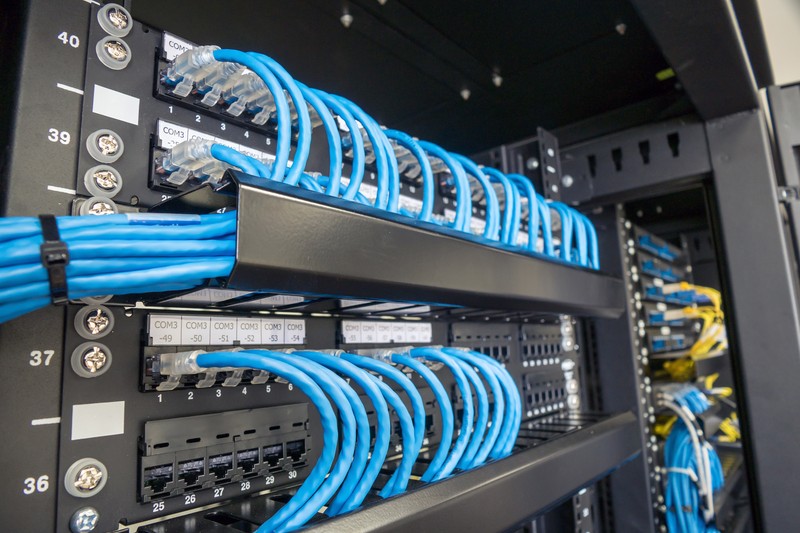
Organization matters here more than almost anywhere else, since technicians visit these spaces constantly for troubleshooting, equipment changes, and expansion. Cable routing, labeling, ventilation, power availability, and physical access all deserve attention at the design stage rather than after the first crowded rack has been filled.
5. Horizontal Structured Cabling
Horizontal structured cabling connects telecommunications rooms to the outlets and devices in individual work areas. These runs travel through ceilings, walls, floors, and other approved pathways before terminating at workstations and the equipment sitting on them.
This portion of the infrastructure determines the connectivity available to employees directly. Computers, IP phones, wireless access points, printers, and security devices all reach the network through it, and cable category, distance limits, pathway design, and termination quality each influence how well they perform.
Horizontal structured cabling should never be treated as an afterthought. Poorly installed or undocumented runs create connectivity faults that become genuinely difficult to diagnose once walls, ceilings, and finished spaces have closed over them.
6. Work Area Components
Work area components form the final connection between the cabling system and the devices employees use. This covers telecommunications outlets, patch cords, connectors, and the supporting hardware sitting within each individual workspace.
The work area is where employees meet the network directly, and a correctly installed outlet paired with a suitable patch cable is what makes that connection feel unremarkable. Standardized components also make office churn easier to absorb, so a department reshuffle becomes a matter of reconnecting equipment rather than commissioning new cable runs.
Understanding Structured Cabling Data Center Requirements
Structured cabling data center projects demand tighter planning, since these environments concentrate a great deal of technology into a small footprint and usually support operations the business cannot afford to interrupt. Cable density, airflow, rack placement, redundancy, pathway capacity, and documentation all carry more weight than they would in an office fit-out.
Data center cabling also has to accommodate equipment changes without disruption. Disciplined rack organization and cable management make identification and maintenance straightforward, letting technicians trace connections quickly instead of working backward through an undocumented bundle.
Fiber optic and copper cabling each serve particular purposes within a data center, depending on distance, bandwidth requirements, equipment specifications, and network architecture. Professional planning is what establishes which types and pathways suit the intended application before anything is pulled.
How We Approach a Structured Cabling Project
At Alliance Telecommunications, we treat cabling as the foundation for everything a client installs afterward, whether that is security solutions, conference room technology, or wireless coverage across a warehouse. Our team surveys the building, designs to the standards our certifications reflect as a BICSI corporate member, and documents the finished installation so the next technician on site is not guessing.
We manage the entire low voltage scope in-house, from design through installation and testing, and our service contract packages keep us available once a project closes. For businesses weighing a broader upgrade, our guide to structured cabling for modern business covers how these decisions play out over the life of a building.
Build a Better Foundation for Your Network
A structured cabling system is the physical foundation beneath most of the technology a business uses every day. The six components, from entrance facilities and equipment rooms through to horizontal cabling and work area outlets, each contribute to an infrastructure that stays organized as it scales.
For new construction, office renovations, technology upgrades, and data center projects, planning is what separates infrastructure that supports the business from infrastructure that quietly constrains it. Contact us to discuss your cabling requirements and plan an installation suited to your facility.
FAQs
The six components are entrance facilities, equipment rooms, backbone cabling, telecommunications rooms, horizontal cabling, and work area components. Together they form one standardized infrastructure carrying a building’s voice, data, video, wireless, and security traffic.
Horizontal structured cabling is the portion running from a telecommunications room to the outlets in individual work areas. It travels through ceilings, walls, or floors and delivers network access to workstations, IP phones, wireless access points, and other connected equipment.
Data centers concentrate far more equipment into less space, so cable density, airflow, redundancy, pathway capacity, and documentation all become critical. Planning has to allow for equipment changes without disrupting the operations depending on that infrastructure.